
ADDITIONAL PRECAUTIONS
Extra precautions which are carried out for specific organisms, in addition to Routine Practices. Additional Precautions may include the physical separation from other individuals and/or the use of personal protective equipment to prevent or limit the transmission of potentially infectious agent(s) from colonized or infected individuals to others.
AIRBORNE PRECAUTIONS
A type of Additional Precautions (negative pressure room with door closed and use of a fit-tested N95 respirator if not immune to disease) used to prevent or limit the transmission of potentially infectious agents through airborne droplet nuclei or small particles that may be dispersed over long distances by air currents. Negative pressure rooms are not used in community and home health care settings.
COLONIZATION
The presence and growth of a micro-organism in or on a body but without tissue invasion or cellular injury. The client will be asymptomatic.
CONTACT PRECAUTIONS
A type of Additional Precautions (gloves and gown) used to prevent or limit the transmission of potentially infectious agents via contact with an infected/ colonized person, contaminated objects, or equipment
DROPLET-CONTACT PRECAUTIONS
A type of Additional Precautions (gloves, gown and facial protection) used to prevent or limit the transmission of potentially infectious agents through respiratory secretions by contact with the mucous membranes of the eye, nose, and mouth when providing care within two metres of the client
INFECTION
The entry and multiplication of an infectious agent such as bacteria, viruses, and parasites in the tissues of the host. An infection may be subclinical and not show symptoms, or it may cause clinical signs and be symptomatic.
MODE OF TRANSMISSION
The route that a pathogen or organism is transferred from one host to another. There are three common types of modes of transmission: Contact, Droplet & Contact, and Airborne.
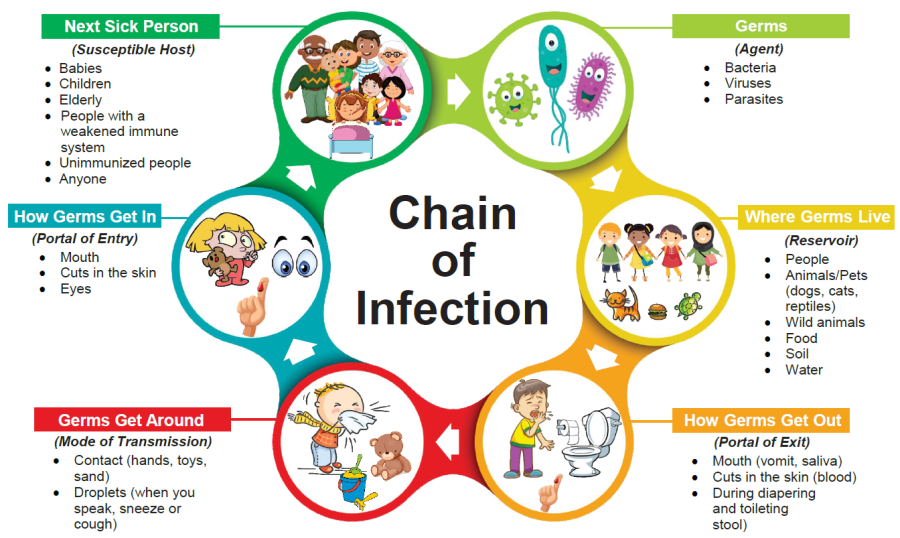
taken from Ottawa Public Health website
PERSONAL PROTECTIVE EQUIPMENT (PPE)
Clothing or equipment worn by health care providers for protection against hazards (gown, gloves, mask/N95 respirator, face/eye protection).
Refer to PPE section for appropriate clothing and equipment to don and doff accordingly to precautions.
RISK ASSESSMENT
An evaluation by the health care provider of the client, their environment, type of contact and the task or procedure to be performed in order to identify hazards and risks associated with exposure to potentially harmful infectious diseases, blood, body fluids, respiratory secretions, excretions, non-intact skin, mucous membranes, body tissues, and contaminated equipment.
ROUTINE PRACTICES
The system of infectious prevention and control practices recommended by the Provincial Infectious Diseases Advisory Committee (PIDAC) as well as the Public Health Agency of Canada (PHAC) to be used by all health care providers with all clients during all care to prevent and control transmission of micro-organisms.
